


PCSE updates on contact details and pooled lists
Correct contact details
Practices can improve communications with PCSE by ensuring that they have the most up to date practice contact details, including:
- The main practice contact
- All user administrators
- The designated Performers List approver
- The designated GP Payments & Pensions (GPPP) approver
These may be the same person. However, providing PCSE with contact details for each role will improve communications. As a minimum, PCSE would like the name of a user administrator for each of the following key areas:
|
Area within the practice |
Key contact |
|
Suppliers & Logistics |
Main Practice Contact |
|
Performers List |
PL Organisation Administrator |
|
GP Pensions & Payments |
GPPP Practice User Management |
All user administrators will need to be verified by PCSE by completing a form and getting Caldicott Guardian approval, and PCSE’s User Registration Team will work with you through this process if required.
In many practices the user administrator for these three areas will be the practice manager, but in some practices the role will be split across two or three staff members. It is important that PCSE has the correct contact details and information on the lead area for each person.
The user administrator role has to be set up on the system by PCSE. Once this is in place the administrator can decide whether to create other roles within the practice to spread the workload and allow the development of a relationship with PCSE. Such roles include the Performers List organisation approver and a GP Payments & Pensions (GPPP) approver.
Below is a page from PCSE’s user management guidance showing the tasks that fall in each role:
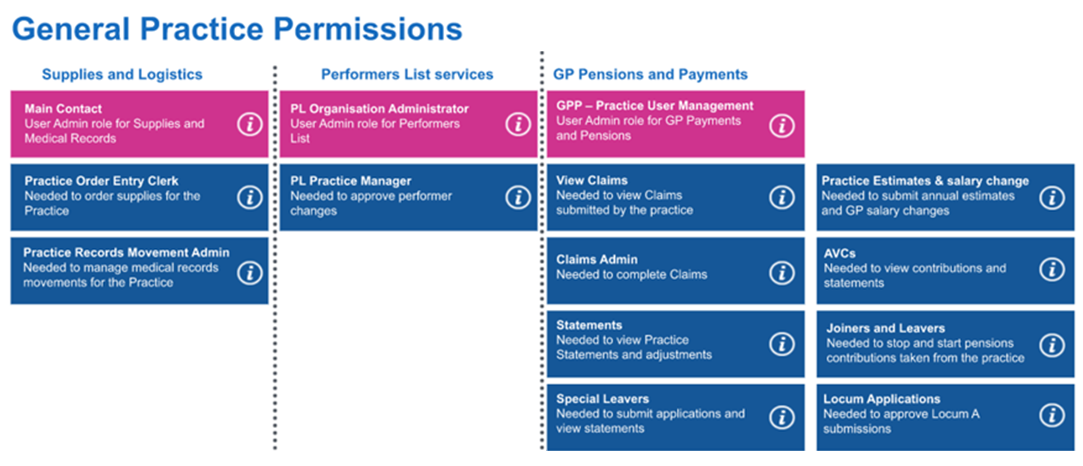
A Performers List Organisation Approver – is the person (often the practice manager) in the practice who addresses changes that affect the Performers List. This could include a new partner joining, a partner retiring, or a GP taking 24-hour retirement. Read further information on PCSE and the Performers List.
More information for practice managers, or other personnel taking on the Performers List Approver role is here.
A GP Payments & Pensions (GPPP) approver – is the person in the practice who is responsible for all aspects of payment and pensions. This can include bank detail changes, childhood immunisation payments, practice mergers, pensions online enquiries etc.
Giving PCSE the name and contact details of a dedicated person within the practice will help them communicate more swiftly, particularly if forms have not been correctly completed or they have any queries.
For each area, the PCSE team want the name of one person they can direct all correspondence to. If you have not already supplied the contact details of your user administrator(s) and a PL organisation approver and/or GPPP approver to PCSE then please do so as soon as possible even if this person is already on their data base as ‘practice manager’, ‘lead clinician’ etc.
Further information on PCSE and the Performers List.
Further information on user management.
Pooled lists
PCSE recommend that practices still operating personalised lists should consider moving to pooled ones. This subject was raised at a recent PCSE webinar, along with an eight-minute video on how to make the transition. The public questions and answers under the video may also be useful to practices.
Some of the benefits of having a pooled list are:
- No need to bulk transfer patients when a GP joins or leaves the practice.
- Practices can divide patients’ usual/named GP between salaried and partner GPs without notifiying PCSE.
- Reduction in errors on GP links (as nothing can be sent to invalid GP codes).
Identifying patients living with frailty (23 Oct 2017)
Since July 2017 there has been a new contractual requirement for practices to focus on the identification and management of patients living with frailty. Practices are required to use appropriate...Remember that your practice needs a CQC registered manager (23 Oct 2017)
Remember that Section 33 of the Health and Social Care Act 2008 states that it is a legal requirement for practices to have a registered manager with the CQC (Care...New GMS1 form - use now (23 Oct 2017)
All practices should have received new GMS1 forms to use from this month onwards. The new forms include supplementary questions to be completed by overseas...LMC patient engagement project wins award at RCGP conference (19 Oct 2017)
Londonwide LMCs’ Patient Engagement Project (PEP) was launched in July 2016 with a focus on supporting practices in fostering and developing Patient Participation Groups (PPGs). The experiences and views of...Working as a team helps combat workload stress (19 Oct 2017)
Alison Dalal, practice manager at the Paddington Green Health Centre, shares her top tips. As surveys show, working in general practice can be a stressful business and as the workload...Jeremy Hunt pledges ‘state-backed’ indemnity (19 Oct 2017)
Speaking at this month’s Royal College of General Practitioners conference Jeremy Hunt announced he is planning to introduce a state-backed indemnity scheme from April 2019. It will cover all GPs...NHS chief says networking may be answer to working at scale (19 Oct 2017)
NHS Chief Executive Simon Stevens told the Health Select Committee earlier this month that “more networked approaches” can also be an answer to working ‘at scale’. This places the NHS...BMA issues advice on premises fees (20 Sep 2017)
As NHS Property Services emails practices with invoices and/or a letter from Mark Day, Chief Financial Officer at Community Health Partnerships the BMA has issued advice to practices. The covering...Londonwide LMCs' September 2017 newsletter (20 Sep 2017)
Future GP workforce plans for London (19 Sep 2017)
The Mayor of London, Sadiq Khan commissioned The King’s Fund and Nuffield Trust to undertake an independent analysis of sustainability and transformation plans (STP) in London. The full 98...Guidance
We provide expert guidance for practices in our guidance section, as well as an archive of other materials you may find useful.
GP Support
Contact our GP Support team if you need help or advice.
The team provide professional and pastoral support to GPs and practice teams on a broad range of issues.
follow us on...


