


PCSE updates on contact details and pooled lists
Correct contact details
Practices can improve communications with PCSE by ensuring that they have the most up to date practice contact details, including:
- The main practice contact
- All user administrators
- The designated Performers List approver
- The designated GP Payments & Pensions (GPPP) approver
These may be the same person. However, providing PCSE with contact details for each role will improve communications. As a minimum, PCSE would like the name of a user administrator for each of the following key areas:
|
Area within the practice |
Key contact |
|
Suppliers & Logistics |
Main Practice Contact |
|
Performers List |
PL Organisation Administrator |
|
GP Pensions & Payments |
GPPP Practice User Management |
All user administrators will need to be verified by PCSE by completing a form and getting Caldicott Guardian approval, and PCSE’s User Registration Team will work with you through this process if required.
In many practices the user administrator for these three areas will be the practice manager, but in some practices the role will be split across two or three staff members. It is important that PCSE has the correct contact details and information on the lead area for each person.
The user administrator role has to be set up on the system by PCSE. Once this is in place the administrator can decide whether to create other roles within the practice to spread the workload and allow the development of a relationship with PCSE. Such roles include the Performers List organisation approver and a GP Payments & Pensions (GPPP) approver.
Below is a page from PCSE’s user management guidance showing the tasks that fall in each role:
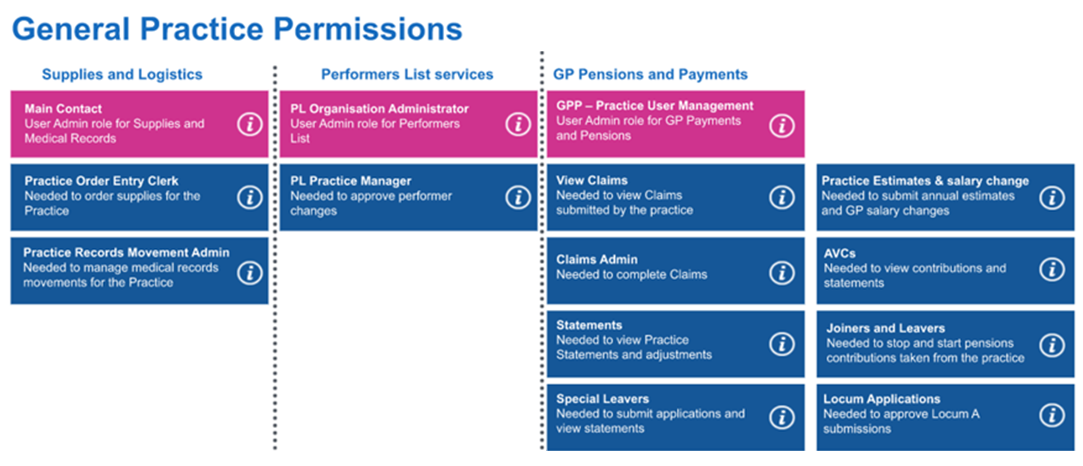
A Performers List Organisation Approver – is the person (often the practice manager) in the practice who addresses changes that affect the Performers List. This could include a new partner joining, a partner retiring, or a GP taking 24-hour retirement. Read further information on PCSE and the Performers List.
More information for practice managers, or other personnel taking on the Performers List Approver role is here.
A GP Payments & Pensions (GPPP) approver – is the person in the practice who is responsible for all aspects of payment and pensions. This can include bank detail changes, childhood immunisation payments, practice mergers, pensions online enquiries etc.
Giving PCSE the name and contact details of a dedicated person within the practice will help them communicate more swiftly, particularly if forms have not been correctly completed or they have any queries.
For each area, the PCSE team want the name of one person they can direct all correspondence to. If you have not already supplied the contact details of your user administrator(s) and a PL organisation approver and/or GPPP approver to PCSE then please do so as soon as possible even if this person is already on their data base as ‘practice manager’, ‘lead clinician’ etc.
Further information on PCSE and the Performers List.
Further information on user management.
Pooled lists
PCSE recommend that practices still operating personalised lists should consider moving to pooled ones. This subject was raised at a recent PCSE webinar, along with an eight-minute video on how to make the transition. The public questions and answers under the video may also be useful to practices.
Some of the benefits of having a pooled list are:
- No need to bulk transfer patients when a GP joins or leaves the practice.
- Practices can divide patients’ usual/named GP between salaried and partner GPs without notifiying PCSE.
- Reduction in errors on GP links (as nothing can be sent to invalid GP codes).
Provider Development Masterclasses (31 Mar 2016)
This series of day-long masterclasses aims to equip participants with relevant, practical business skills and knowledge that they can take back and use in their localities. Topics have been selected...RCGP guide to supporting information for appraisal and revalidation (30 Mar 2016)
The RCGP has approved a new guide to supporting information for appraisal and revalidation (March 2016) that aims to reduce inconsistencies in interpretation and streamline the process of providing...London GP Registration for Offenders (30 Mar 2016)
Londonwide LMCs welcomes the London GP Registration for Offenders initiative, it helps practices deal with the needs of an often vulnerable and challenging group of patients. Offenders have exactly the same rights...Patient online access for children aged 11-16 years (24 Mar 2016)
NHS England (NHSE) and the Royal College of General Practitioners (RCGP) have produced some helpful guidance about proxy access regarding Patient Online. The full guidance is available here and...Budget 2016 (17 Mar 2016)
Budget 2016 was, on the whole, fairly innocuous for health professionals. There were very few health-specific announcements (some money for children’s hospitals outside London) and a couple of measures that...New Housing Application letter and poster (17 Mar 2016)
Our new waiting room poster and template practice letter will help practice staff manage requests for letters supporting housing applications.Patient Online detailed coded record (DCR) deadline is 31 March 2016 (16 Mar 2016)
This month sees the deadline for enabling online access to patients’ detailed coded record (DCR). Practices have until 31 March 2016 to switch this on. The latest figures we...PMS contract reviews update (16 Mar 2016)
We recently issued our third PMS (Personal Medical Services) bulletin on the reviews taking place across London. Our bulletins are designed to bring you the current PMS contract review information...New Men B immunisation advice (16 Mar 2016)
Following recent high profile stories about child deaths from meningitis B, Public Health England has issued further advice: Men B immunisation programme Following recent media coverage about the death of...Guidance
We provide expert guidance for practices in our guidance section, as well as an archive of other materials you may find useful.
GP Support
Contact our GP Support team if you need help or advice.
The team provide professional and pastoral support to GPs and practice teams on a broad range of issues.
follow us on...


