


PCSE updates on contact details and pooled lists
Correct contact details
Practices can improve communications with PCSE by ensuring that they have the most up to date practice contact details, including:
- The main practice contact
- All user administrators
- The designated Performers List approver
- The designated GP Payments & Pensions (GPPP) approver
These may be the same person. However, providing PCSE with contact details for each role will improve communications. As a minimum, PCSE would like the name of a user administrator for each of the following key areas:
|
Area within the practice |
Key contact |
|
Suppliers & Logistics |
Main Practice Contact |
|
Performers List |
PL Organisation Administrator |
|
GP Pensions & Payments |
GPPP Practice User Management |
All user administrators will need to be verified by PCSE by completing a form and getting Caldicott Guardian approval, and PCSE’s User Registration Team will work with you through this process if required.
In many practices the user administrator for these three areas will be the practice manager, but in some practices the role will be split across two or three staff members. It is important that PCSE has the correct contact details and information on the lead area for each person.
The user administrator role has to be set up on the system by PCSE. Once this is in place the administrator can decide whether to create other roles within the practice to spread the workload and allow the development of a relationship with PCSE. Such roles include the Performers List organisation approver and a GP Payments & Pensions (GPPP) approver.
Below is a page from PCSE’s user management guidance showing the tasks that fall in each role:
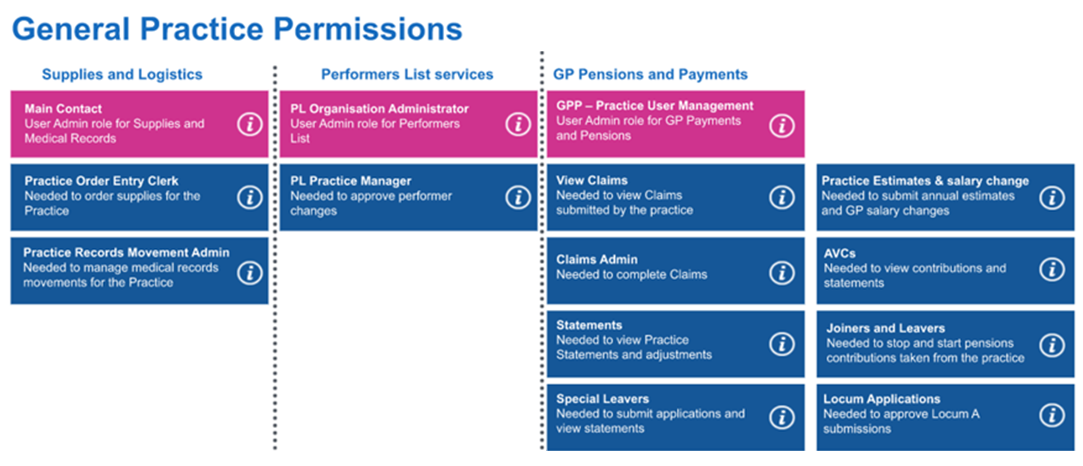
A Performers List Organisation Approver – is the person (often the practice manager) in the practice who addresses changes that affect the Performers List. This could include a new partner joining, a partner retiring, or a GP taking 24-hour retirement. Read further information on PCSE and the Performers List.
More information for practice managers, or other personnel taking on the Performers List Approver role is here.
A GP Payments & Pensions (GPPP) approver – is the person in the practice who is responsible for all aspects of payment and pensions. This can include bank detail changes, childhood immunisation payments, practice mergers, pensions online enquiries etc.
Giving PCSE the name and contact details of a dedicated person within the practice will help them communicate more swiftly, particularly if forms have not been correctly completed or they have any queries.
For each area, the PCSE team want the name of one person they can direct all correspondence to. If you have not already supplied the contact details of your user administrator(s) and a PL organisation approver and/or GPPP approver to PCSE then please do so as soon as possible even if this person is already on their data base as ‘practice manager’, ‘lead clinician’ etc.
Further information on PCSE and the Performers List.
Further information on user management.
Pooled lists
PCSE recommend that practices still operating personalised lists should consider moving to pooled ones. This subject was raised at a recent PCSE webinar, along with an eight-minute video on how to make the transition. The public questions and answers under the video may also be useful to practices.
Some of the benefits of having a pooled list are:
- No need to bulk transfer patients when a GP joins or leaves the practice.
- Practices can divide patients’ usual/named GP between salaried and partner GPs without notifiying PCSE.
- Reduction in errors on GP links (as nothing can be sent to invalid GP codes).
GPC regional election nominations 2017 (22 Feb 2017)
Nominations are open for the round of GPC regional elections to cover terms from 2017-20, in London two seats are up for election: Hillingdon, Brent, Harrow, Ealing, Hammersmith and...NHS England guidance on managing conflicts of interest (22 Feb 2017)
NHS England has just published new guidance on managing conflicts of interest which comes into effect from 1 June 2017. The guidance aims to: Introduce common principles and rules...Submission to new All Party Parliamentary Group Primary Care and Public Health Inquiry (22 Feb 2017)
Londonwide LMCs has been invited to submit evidence to the All Party Parliamentary Group on Primary Care and Public Health's new inquiry into managing demand in primary care. As we...Workforce Survey - latest results (22 Feb 2017)
Thank you for supporting our November 2016 Workforce Survey. We had a fantastic response from 552 unique practices across the 1295 practices we represent in the Capital. That is the...London Ambulance Service Research Project (21 Feb 2017)
The London Ambulance Service (LAS) is running a research project linking ambulance data to emergency department data, enabling them to look at a patient record from their 999 call to...Prospective Employers requests to see copies of appraisal summaries (21 Feb 2017)
It has been reported to us that some prospective employers have been asking candidates to share their appraisal summary. Our view, which is supported by colleagues on the GPC, is...2017/18 GP contract (20 Feb 2017)
The key elements of the new contract agreement are as follows, full details can be found on the BMA website: Direct Enhanced Services The Avoiding Unplanned Admissions (AUA) DES...Guest blog - life as a refugee doctor in the UK (20 Feb 2017)
This month our guest blog comes from Dr Helal Attayee, who arrived in the UK as a refugee and has gone through the process of getting the necessary qualifications to...The NHS winter crisis and the Prime Minister’s run-in with GPs (26 Jan 2017)
The NHS winter crisis and the Prime Minister’s run-in with GPs The weekend of 14 January saw general practice and Theresa May come to blows over claims about the impact...Winter health watch summaries (26 Jan 2017)
The Government’s weekly updates on the prevalence of winter illnesses and weather conditions in England can be found on the gov.uk website The data for the reports comes from four...Guidance
We provide expert guidance for practices in our guidance section, as well as an archive of other materials you may find useful.
GP Support
Contact our GP Support team if you need help or advice.
The team provide professional and pastoral support to GPs and practice teams on a broad range of issues.
follow us on...


