


PCSE updates on contact details and pooled lists
Correct contact details
Practices can improve communications with PCSE by ensuring that they have the most up to date practice contact details, including:
- The main practice contact
- All user administrators
- The designated Performers List approver
- The designated GP Payments & Pensions (GPPP) approver
These may be the same person. However, providing PCSE with contact details for each role will improve communications. As a minimum, PCSE would like the name of a user administrator for each of the following key areas:
|
Area within the practice |
Key contact |
|
Suppliers & Logistics |
Main Practice Contact |
|
Performers List |
PL Organisation Administrator |
|
GP Pensions & Payments |
GPPP Practice User Management |
All user administrators will need to be verified by PCSE by completing a form and getting Caldicott Guardian approval, and PCSE’s User Registration Team will work with you through this process if required.
In many practices the user administrator for these three areas will be the practice manager, but in some practices the role will be split across two or three staff members. It is important that PCSE has the correct contact details and information on the lead area for each person.
The user administrator role has to be set up on the system by PCSE. Once this is in place the administrator can decide whether to create other roles within the practice to spread the workload and allow the development of a relationship with PCSE. Such roles include the Performers List organisation approver and a GP Payments & Pensions (GPPP) approver.
Below is a page from PCSE’s user management guidance showing the tasks that fall in each role:
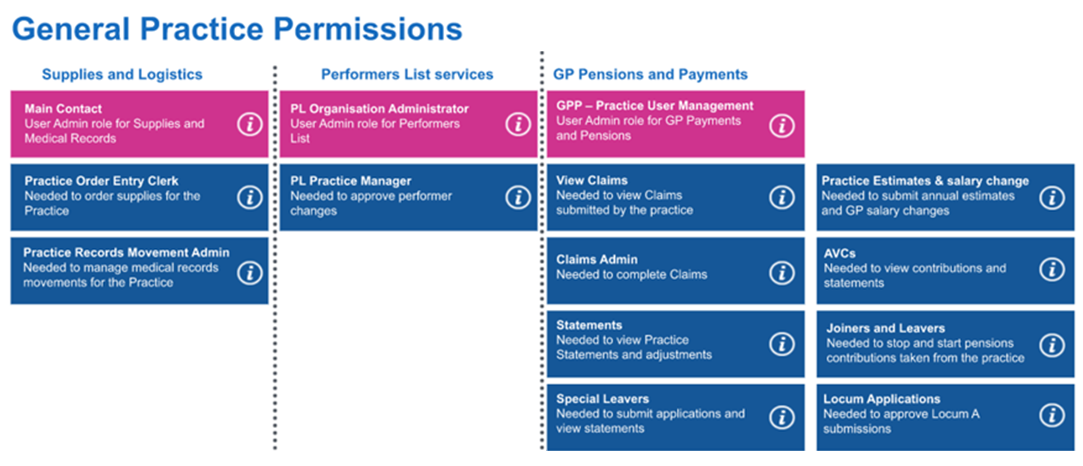
A Performers List Organisation Approver – is the person (often the practice manager) in the practice who addresses changes that affect the Performers List. This could include a new partner joining, a partner retiring, or a GP taking 24-hour retirement. Read further information on PCSE and the Performers List.
More information for practice managers, or other personnel taking on the Performers List Approver role is here.
A GP Payments & Pensions (GPPP) approver – is the person in the practice who is responsible for all aspects of payment and pensions. This can include bank detail changes, childhood immunisation payments, practice mergers, pensions online enquiries etc.
Giving PCSE the name and contact details of a dedicated person within the practice will help them communicate more swiftly, particularly if forms have not been correctly completed or they have any queries.
For each area, the PCSE team want the name of one person they can direct all correspondence to. If you have not already supplied the contact details of your user administrator(s) and a PL organisation approver and/or GPPP approver to PCSE then please do so as soon as possible even if this person is already on their data base as ‘practice manager’, ‘lead clinician’ etc.
Further information on PCSE and the Performers List.
Further information on user management.
Pooled lists
PCSE recommend that practices still operating personalised lists should consider moving to pooled ones. This subject was raised at a recent PCSE webinar, along with an eight-minute video on how to make the transition. The public questions and answers under the video may also be useful to practices.
Some of the benefits of having a pooled list are:
- No need to bulk transfer patients when a GP joins or leaves the practice.
- Practices can divide patients’ usual/named GP between salaried and partner GPs without notifiying PCSE.
- Reduction in errors on GP links (as nothing can be sent to invalid GP codes).
October 2015 newsletter now available (15 Oct 2015)
Londonwide LMCs NewsletterTamiflu in nursing and care homes (14 Oct 2015)
In January the GPC sought legal advice on Public Health England’s (PHE) instructions to prescribe Tamiflu for the prophylaxis of influenza in nursing and care homes where there have been...Improving well-being and health for dementia patients workshop (14 Oct 2015)
WHELD Research Programme (Improving Wellbeing and Health in Dementia) have organised an Royal College of General Practitioners accredited workshop for GPs in London. It will discuss anti-psychotic medication and no-pharmacological...Clinical Commissioning Group Outcomes Indicator Set - participation voluntary (14 Oct 2015)
Advice has been sought from the BMA General Practitioners Committee’s IT Subcommittee on the Clinical Commissioning Group Outcomes Indicator Set (CCG OIS) for 2013/14 and 2014/15. Practices have been asked to sign...Year-end deadline for agreement of GP Systems of Choice and GP IT services (14 Oct 2015)
NHS England has published an agreement for signature by practices and Clinical Commissioning Groups (CCGs) setting out the provision of GP Systems of Choice (GPSoC) and GP IT services. The...Death in service benefits for locum GPs - are you covered? (14 Oct 2015)
You may already be aware that there are persistent current inequities regarding the entitlement to ‘death in service’ benefit for freelance/ locum GPs compared to their principal or salaried GP...Healthwatch ask General Practice Committee for transparency on additional charges (14 Oct 2015)
The General Practitioners Committee (GPC) recently met with Healthwatch England to discuss charges that GPs can make for work not covered by their contract. Whilst the patient group understands the...New London Ambulance Service proposals to introduce non-emergency transport (14 Oct 2015)
London Ambulance Service (LAS) have consulted with us about a new service which they are implementing to help them manage the need for emergency ambulances more efficiently. A letter outlining...Meningococcal B for infants – FAQs update (14 Oct 2015)
NHS Employers have updated their vaccs and imms FAQs in relation to meningococcal B for infants to explain the eligible age cohort (2 – 13 months), as well as a catch-up...Nursing and Midwifery Council revalidation (14 Oct 2015)
The Nursing and Midwifery Council (NMC) have introduced revalidation for all nurses and midwives in the UK: the most significant change to regulation in a generation. Revalidation means that everyone...Guidance
We provide expert guidance for practices in our guidance section, as well as an archive of other materials you may find useful.
GP Support
Contact our GP Support team if you need help or advice.
The team provide professional and pastoral support to GPs and practice teams on a broad range of issues.
follow us on...


